

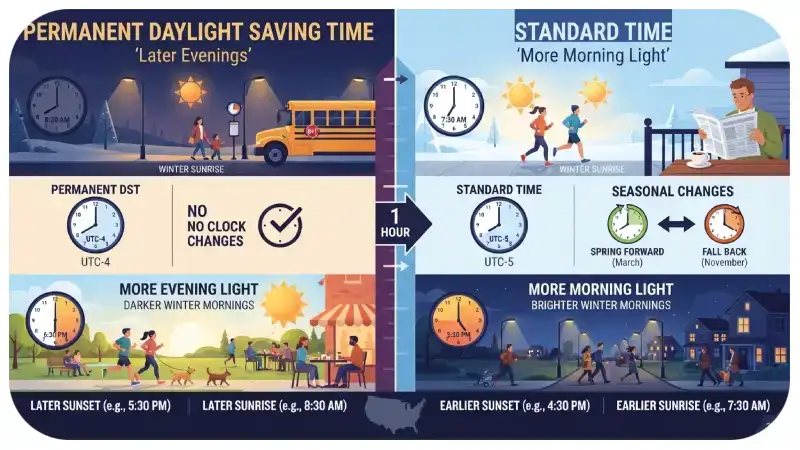
Twice a year, most Americans reset their clocks. In spring, they lose an hour of sleep. In fall, they gain it back—and often feel just as off-kilter. The frustration has fueled a long-running debate: what if the country simply stopped switching? That idea sits at the heart of permanent daylight savings time.
This article explains what permanent daylight savings time actually means, how the system would function in practice, where the United States stands on the proposal as of late 2026, and what everyday life would look like if the change took effect. You will also find a clear comparison with permanent standard time so you can weigh the real trade-offs yourself.
What Permanent Daylight Savings Time Actually Means
Under the current system, most of the United States observes daylight saving time from the second Sunday in March until the first Sunday in November. Clocks move forward one hour in spring and back one hour in fall. Standard time rules the remaining months.
Permanent daylight savings time would lock the clocks on the advanced schedule year-round. There would be no more “spring forward” or “fall back.” The time that is now called daylight saving time would become the permanent civil time for the majority of the country.
In practical terms, that means the sun would rise and set one hour later than it does under standard time. On a December morning in a northern city, sunrise might not arrive until after 8 a.m. In the evening, the extra hour of daylight would stretch further into the after-work and after-school hours.
Two states already sit outside the seasonal switch. Arizona (except the Navajo Nation) and Hawaii observe permanent standard time. Federal law currently allows states to opt out of daylight saving time entirely, but it does not allow them to stay on daylight saving time all year. That restriction is why the national conversation has centered on Congress.
How Permanent Daylight Savings Time Would Work Day to Day
If the change became law, the practical effects would appear most clearly in winter. Morning light would arrive later. School bus routes, early work shifts, and morning exercise routines would begin in darker conditions. Evening activities—outdoor sports, retail shopping, dining on patios—would enjoy an extra hour of natural light.
Summer would feel more familiar. The long evenings people already experience under daylight saving time would continue without interruption. The major difference is the absence of the twice-yearly disruption. No more adjusting clocks, missing appointments, or feeling the short-term fatigue that follows each transition.
Time zones themselves would not disappear. Eastern, Central, Mountain, and Pacific zones would remain. The only shift would be that each zone would stay on its daylight-saving offset instead of alternating. Devices that update automatically would need only a one-time software adjustment; after that, the seasonal dance would end.
Energy use, traffic patterns, and business hours would gradually adapt. Studies on seasonal daylight saving have shown modest reductions in evening electricity demand for lighting, though air-conditioning loads and morning lighting can offset some of those gains. The net effect of a permanent change would depend on local climate, latitude, and lifestyle patterns.
Current Status of Permanent Daylight Savings Time in the United States
As of September 2026, the United States still changes clocks twice a year. The next scheduled switch is November 1, 2026, when most clocks will fall back one hour at 2 a.m. local time.
Momentum for change has grown. On July 14, 2026, the House of Representatives passed the Sunshine Protection Act (H.R. 139) by a bipartisan vote of 308–117. The bill would make daylight saving time the permanent standard across most of the country while still allowing states that prefer permanent standard time to opt out. The measure now sits in the Senate, where no vote has been scheduled.
Nineteen states have already passed laws or resolutions supporting year-round daylight saving time. Those states include Florida, Texas, Washington, Tennessee, and others. Their laws are written to take effect only if federal law changes. Until Congress acts, the state measures remain dormant.
President Donald Trump has publicly supported ending the clock changes and keeping the later evening light. Whether the Senate advances the bill before the November switch remains uncertain. Until a final law is signed, the existing schedule under the Uniform Time Act continues.
Pros and Cons of Locking the Clocks on Daylight Saving Time
Supporters of permanent daylight savings time emphasize lifestyle and economic benefits. Later sunsets give people more usable daylight after work and school. Outdoor recreation, evening retail, and restaurant traffic often increase when the light lasts longer. Many parents and coaches prefer the extra hour for after-school sports. Eliminating the biannual switch also removes a known source of short-term sleep disruption, traffic accidents, and workplace errors that spike in the days after each change.
Critics, including major sleep and medical organizations, raise health and safety concerns. The American Academy of Sleep Medicine and other groups argue that permanent standard time aligns better with human circadian rhythms. Morning light is a powerful cue for the body’s internal clock. Under permanent daylight saving time, winter sunrises in northern latitudes could stretch past 8:30 or even 9 a.m. Dark morning commutes and school starts raise worries about pedestrian safety, especially for children. Some research links chronic misalignment between clock time and solar time to higher risks of certain health problems.
A middle position also exists: keep the seasonal switch. Defenders of the status quo note that the current system already delivers evening light in the warmer months while preserving morning light in winter. Yet public opinion polls consistently show most Americans want the switching to stop; the disagreement is mainly over which permanent setting to choose.
How Permanent Daylight Savings Time Compares With Permanent Standard Time
The two permanent options produce opposite light patterns.
Under permanent daylight savings time:
- Winter mornings stay darker longer.
- Winter and summer evenings stay brighter longer.
- No clock changes.
Under permanent standard time:
- Winter mornings receive earlier sunrise.
- Summer evenings end earlier than people now experience.
- No clock changes.
Arizona and Hawaii already live under the second model. Their experience shows that permanent standard time is workable, though residents in those states still notice the early summer sunsets relative to neighboring regions that observe daylight saving time.
Latitude matters. Places farther north experience more extreme seasonal shifts in daylight. A permanent change that feels mild in Florida can feel dramatic in Minnesota or Washington state. Time-zone geography also plays a role: locations on the western edge of a time zone already see later sunrises and sunsets than locations on the eastern edge.
Practical Steps Readers Can Take Right Now
Until federal law changes, the existing schedule remains in force. Mark November 1, 2026, on your calendar if you live in a state that observes the switch. Update any manual clocks, appliances, and medical devices that do not adjust automatically.
If you care about the outcome, contact your senators. The House has already voted; the next decision rests with the Senate. State-level laws supporting permanent daylight savings time demonstrate clear local preference in nineteen states, but those preferences cannot take effect without congressional action.
Parents and early-shift workers may want to plan for darker mornings if the permanent change advances. Simple steps—reflective clothing, well-lit walkways, and slightly adjusted departure times—can reduce risk during the transition period.
Looking Ahead
The debate over permanent daylight savings time is no longer abstract. A major House vote, presidential support, and nearly twenty state laws have moved the issue closer to a national decision than at any point in recent years. Whether the final outcome is year-round daylight saving time, year-round standard time, or continued seasonal switching, the core desire is the same: end the twice-yearly disruption and settle on a system that better matches how people actually live.
Understanding what permanent daylight savings time means and how it would work gives you the tools to follow the debate, evaluate the trade-offs, and decide what kind of daily light pattern you prefer for your own household and community.










Leave a Reply