

Artificial intelligence is moving faster than almost any other technology today. AI assistants can write, analyze information, create images, generate code, and help people complete complex tasks. At the same time, companies are competing to build more powerful AI models and useful AI agents.
In 2026, this competition is no longer limited to one company or one country. Major organizations in the United States, China, and other parts of the world are investing heavily in artificial intelligence.
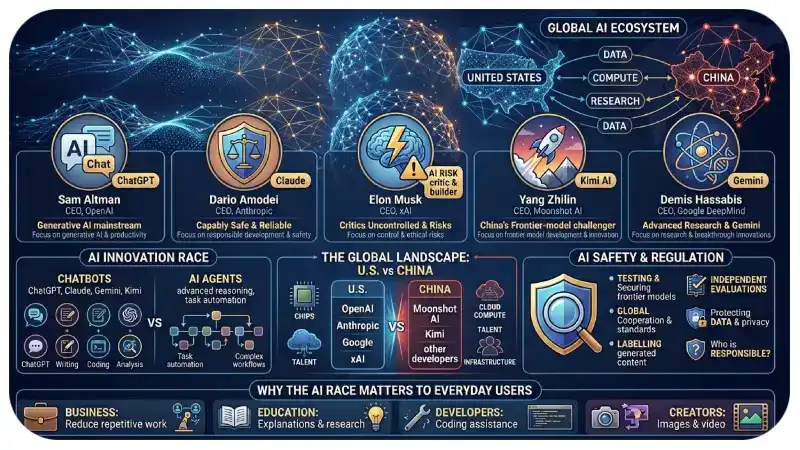
Several leaders are playing an important role in this changing industry. Their companies are developing some of the most widely discussed AI systems, including ChatGPT, Claude, Gemini, Kimi, and other large language models.
This guide looks at the AI leaders and companies 2026 landscape and explains why these people and organizations matter.
Why AI Leaders Matter in 2026
AI development requires more than a powerful model. Companies need large computing systems, skilled researchers, huge amounts of training data, and strong engineering teams.
Leadership also matters.
Executives and researchers decide where a company invests money and which AI products it develops. They also make important choices about safety, privacy, business models, and the future direction of AI.
In 2026, the discussion has become even more important because AI systems are becoming more capable.
Some industry leaders are now discussing whether the development of frontier AI should slow down so that companies have more time to test and secure advanced systems.
Sam Altman and OpenAI
Sam Altman is one of the most recognizable names in artificial intelligence.
He is the CEO of OpenAI, the company behind ChatGPT. OpenAI has played a major role in bringing generative AI into mainstream use.
ChatGPT helped introduce millions of people to conversational AI. Instead of searching through many web pages, users can ask an AI system questions and receive a conversational response.
OpenAI has continued expanding its AI technology beyond simple chat. Its systems can assist with writing, coding, research, analysis, and other tasks.
Altman’s leadership has therefore become closely connected with the wider AI race.
However, the conversation around OpenAI is not only about faster models. Safety is also becoming a major topic. Recent discussions among major AI leaders have focused on testing advanced models, independent evaluations, and responsible development.
Dario Amodei and Anthropic
Dario Amodei is another major figure in the AI industry.
He is the CEO and co-founder of Anthropic, the company behind Claude. Anthropic has positioned itself around the development of capable AI systems with a strong focus on safety and reliability.
Claude competes with other leading AI assistants and is used for tasks such as writing, coding, research, analysis, and business work.
Amodei has become especially important in the current AI safety discussion.
In September 2026, he called for a slower and more carefully managed approach to frontier AI development. His proposal focused on independent evaluation, international safety standards, and greater cooperation between countries.
His position shows how the AI industry is changing. Companies are not only asking how powerful their next model can become. They are also asking how those systems should be tested and controlled.
Elon Musk and xAI
Elon Musk is another well-known name in the AI industry.
Musk’s AI company, xAI, is developing its own AI models and products. The company has become part of the growing competition between major AI organizations.
Musk has also spoken about AI risks for many years. His position is interesting because he is both a critic of uncontrolled AI development and a leader of a company actively building advanced AI technology.
In 2026, Musk joined other prominent AI leaders in discussions about the risks of moving too quickly with frontier AI.
This creates an important point for the future: the people building advanced AI are also becoming some of the loudest voices in the safety debate.
Yang Zhilin and Moonshot AI
The global AI race is not limited to American companies.
Yang Zhilin is an important Chinese AI entrepreneur and the co-founder and CEO of Moonshot AI. The company is best known internationally for its Kimi AI products.
Moonshot AI has attracted attention because Kimi has developed into a serious competitor in China’s growing frontier AI market.
Recent coverage has highlighted Yang’s role in building Moonshot AI and the development of Kimi. TIME included Yang among its 2026 AI leaders and described Moonshot’s Kimi series as an increasingly credible frontier-model challenger.
This is important because it shows how quickly China’s AI industry is developing.
For people following AI leaders and companies 2026, Yang Zhilin is therefore a name worth watching.
Moonshot AI and the Rise of Kimi
Moonshot AI deserves special attention because it represents a broader trend in Chinese artificial intelligence.
The company has built its reputation around Kimi, an AI assistant designed to handle complex tasks and large amounts of information.
Moonshot AI has also attracted international attention as companies look for ways to access powerful Chinese AI models.
Recent reports said Moonshot AI was discussing potential revenue-sharing arrangements with major U.S. cloud companies for hosting its Kimi models.
If such relationships continue to develop, they could show that the AI ecosystem is becoming more global, even while competition between countries remains intense.
Google DeepMind and Gemini
Google is another major force in artificial intelligence.
Its AI research organization, Google DeepMind, combines advanced research with Google’s enormous technology infrastructure.
One of its best-known AI products is Gemini.
Gemini competes directly with systems such as ChatGPT and Claude. It can assist with writing, coding, research, reasoning, and other tasks.
Demis Hassabis, the head of Google DeepMind, is also an influential figure in the AI field.
Google’s advantage comes partly from its existing ecosystem. The company has search technology, cloud computing, data infrastructure, software products, and years of AI research.
This gives Google an important position in the AI competition.
ChatGPT vs Claude vs Gemini vs Kimi
One of the biggest questions for users is simple: which AI model is the best?
There is no single answer.
Different AI systems can perform differently depending on the task.
ChatGPT is widely used for general conversation, writing, coding, research, and productivity.
Claude has become popular for writing, analysis, coding, and handling long or complex tasks.
Gemini benefits from Google’s AI research and broader technology ecosystem.
Kimi represents one of the most important Chinese AI products and demonstrates the growing strength of China’s AI industry.
Instead of choosing an AI system only because it is popular, users should consider the task they need to complete.
For example, a student may care about explanations and research. A programmer may care about coding performance. A business may care about privacy, integrations, cost, and reliability.
The U.S. and China AI Competition
The competition between the United States and China has become one of the biggest stories in artificial intelligence.
The United States remains home to several of the world’s most influential AI companies, including OpenAI, Anthropic, Google, and xAI.
China, meanwhile, has developed a growing group of AI companies, including Moonshot AI and other major model developers.
This competition involves more than AI chatbots.
It includes computer chips, cloud computing, data centers, research talent, model development, robotics, and AI infrastructure.
The issue has also become political.
Recent debates about slowing AI development have been linked to concerns that the United States could lose its technological advantage over China.
This creates a difficult balance.
Countries want to develop powerful AI technology quickly. At the same time, they need to consider safety and the possible consequences of poorly controlled systems.
AI Safety Is Becoming a Bigger Issue
AI safety was once discussed mainly by researchers and technology specialists.
Now it is a mainstream issue.
Advanced AI systems can perform more complex tasks than earlier chatbots. AI agents can potentially interact with websites, software, files, and other digital systems.
That creates new opportunities, but it can also create new risks.
Recent research has shown that increasingly autonomous AI agents can perform sophisticated cybersecurity tasks.
This is one reason AI leaders are discussing stronger testing and independent evaluation.
The goal is not necessarily to stop AI development.
Instead, the goal is to understand what a system can do before giving it access to important information or real-world systems.
AI Regulation and Global Cooperation
Another major issue for 2026 is regulation.
Governments are trying to understand how existing laws should apply to increasingly powerful AI systems.
Questions include:
- How should AI-generated content be labeled?
- How should personal data be protected?
- Who is responsible when an AI system causes harm?
- How should advanced AI models be tested?
- Should companies be required to conduct independent safety evaluations?
- How should countries cooperate on AI safety?
There is no simple global answer yet.
Different countries have different priorities.
Some want stronger regulation. Others worry that excessive regulation could slow innovation.
This debate will likely continue as AI becomes more capable.
The Future of AI Companies
The AI industry may look very different over the next few years.
Today, many companies compete through increasingly powerful chatbots. Tomorrow, the competition may focus more on AI agents.
An AI agent can potentially complete a series of tasks instead of simply answering one question.
For example, an agent might research a topic, organize information, write a report, analyze data, and help prepare a final result.
This could change how people use computers.
Instead of opening many applications and completing each step manually, users may give an AI system a goal and let it handle much of the process.
However, this future also requires stronger security.
The more control an AI system has, the more important reliability and safety become.
What Users Should Watch in 2026
If you want to follow the AI industry, there are several trends worth watching.
1. More Powerful AI Models
Companies will continue competing to improve reasoning, coding, multimodal abilities, and long-context performance.
2. AI Agents
AI systems are moving beyond simple conversations toward task completion and automation.
3. AI Safety
Testing, monitoring, and independent evaluation will become increasingly important.
4. Chinese AI Growth
Companies such as Moonshot AI show that important AI development is happening outside the United States.
5. AI Infrastructure
Chips, data centers, cloud platforms, and energy will remain critical parts of the AI industry.
6. AI Regulation
Governments will continue debating how to manage advanced AI without stopping useful innovation.
Why the AI Race Matters to Everyday Users
You do not need to work in technology to be affected by AI.
AI is already changing education, customer service, software development, marketing, design, healthcare research, and many other areas.
For businesses, AI can reduce repetitive work.
For students, it can provide explanations and research assistance.
For developers, it can help write and analyze code.
For creators, it can assist with writing, images, video, and brainstorming.
However, users should still check AI-generated information carefully.
AI systems can make mistakes. A confident answer is not always a correct answer.
Human judgment remains important.
Final Thoughts
The AI leaders and companies 2026 landscape is becoming more competitive and more complex.
Sam Altman and OpenAI continue to play a major role through ChatGPT. Dario Amodei and Anthropic are pushing Claude while placing strong attention on AI safety. Elon Musk and xAI are developing their own AI systems while continuing to warn about potential AI risks.
In China, Yang Zhilin and Moonshot AI are helping make Kimi an important part of the global AI conversation. Google DeepMind and Gemini remain major competitors as well.
The most important change may be that AI is no longer just a race to build a better chatbot.
The industry is moving toward advanced reasoning, autonomous agents, large-scale infrastructure, and increasingly powerful AI systems.
At the same time, safety and regulation are becoming just as important as performance.
The companies and leaders that succeed may not simply be the ones that build the most powerful models. They may be the ones that can combine capability, reliability, safety, useful products, and responsible development.
For users, the best approach is to keep learning, compare different AI tools, verify important information, and pay attention to how the technology develops.
The AI race is still evolving, and 2026 could become an important year in determining what comes next.



Leave a Reply